
Transformer ageing is largely a story about the thermal stress placed on the insulation system. The cellulose paper and oil that separate and support the windings degrade gradually, and the rate of that degradation depends strongly on the temperature the insulation experiences. Winding hot-spot temperature matters especially, because a small region running hotter than the rest of the winding can age its insulation faster than the transformer's average temperature would suggest.
Transformer aging, as the same process is spelled in American English, is not simply a function of how many years a unit has been in service. Two transformers of the same age can have very different insulation life remaining, depending on how they have been loaded, cooled and maintained. Winding temperature, and the temperature history behind it, is one of the most useful pieces of information for understanding that difference.
This article follows the chain from load to heat, from heat to localized hot spots, and from hot spots to accelerated insulation ageing. It then looks at which temperature data is meaningful for assessing thermal ageing, and where direct fiber optic winding temperature measurement fits in.
Key Takeaways
- Transformer thermal ageing is closely tied to the temperature of the insulation, particularly the cellulose paper around the windings.
- Winding hot spots reflect localized thermal stress better than average winding temperature or top-oil temperature alone.
- Temperature is not the only ageing factor. Moisture, oxygen, oil condition, loading history and cooling performance all play a role.
- Direct winding measurement provides actual temperature data at a chosen location, while indirect methods estimate winding temperature from other quantities.
- Fluorescence fiber optic probes are point sensors. Each probe measures only the location of its sensing tip.
- Monitoring supplies temperature data for assessing thermal stress. It does not directly measure insulation ageing or predict absolute remaining life.
What Is Transformer Ageing?
Transformer ageing is the gradual physical and chemical deterioration of the insulation system over time. In a typical oil-immersed power transformer, the key materials are cellulose (paper and pressboard) and insulating oil. Together they form the oil-paper insulation system that keeps the windings electrically separated and mechanically supported.
Cellulose is the main concern in power transformer ageing. Oil can be filtered, treated or replaced during the life of a transformer, but the paper wrapped around the conductors cannot be practically replaced without rebuilding the winding. As the paper degrades, it loses mechanical strength, and this loss is a central reason why insulation condition often sets the practical limit on transformer life.
It helps to separate chronological age from insulation condition. A transformer that has run at moderate temperatures, with effective cooling and low moisture, may show little insulation deterioration after many years. Another unit of the same age that has seen frequent high loading, restricted cooling or moisture ingress may be in a very different state. Age is a starting point, not a measure of condition.
Thermal stress is the factor engineers can most directly observe and manage during operation. That is why winding temperature and hot-spot temperature receive so much attention in discussions of power transformer ageing.
Why Temperature Accelerates Transformer Ageing
The chemical reactions that break down cellulose proceed faster as temperature rises. Higher insulation temperature leads to faster degradation of the cellulose molecular structure, which in turn leads to faster loss of mechanical strength and a shorter insulation life. The relationship is not linear: the effect of a given temperature increase is larger at higher temperatures.
You may see simple rules of thumb that say insulation life halves for every fixed number of degrees. These rules depend on the reference model, the insulation type and the conditions assumed, so they should not be treated as universal facts. Loading guides such as IEC 60076-7 and IEEE C57.91 describe thermal models and ageing calculations for oil-immersed transformers, and any quantitative life calculation should be based on the specific standard, model and parameters that apply to the transformer in question.
Load and Losses
Heat in a transformer comes from losses. Load current produces losses in the windings, and higher current increases those losses and the heat generated. This raises the winding temperature above the temperature of the surrounding oil.
Load is not the only influence on thermal behavior, however. Ambient temperature, stray losses in structural parts, the condition of the oil and the state of the cooling system all affect how much of the generated heat leaves the winding and how hot the insulation finally becomes.
Cooling Performance
Cooling determines how effectively heat is carried away from the windings and core. Depending on transformer design, this may involve natural oil circulation, forced oil flow, radiators, fans or pumps. When cooling performance declines, for example because of blocked airflow, fouled radiators or a failed fan, temperatures for the same load can be noticeably higher.
Two transformers carrying the same load can therefore experience different insulation temperatures. This is one reason load history alone does not describe thermal ageing, and why temperature data adds information that current measurements cannot.
Winding Temperature, Hot-Spot Temperature and Top-Oil Temperature
These three terms are often mixed together, but they describe different things. Top-oil temperature is measured in the upper part of the oil. Winding temperature usually refers to the temperature of the winding conductors or the surrounding insulation. Winding hot-spot temperature is the highest temperature within the winding, which is generally the most relevant value for insulation ageing.
| Temperature Parameter | What It Represents | How It Is Obtained | Why It Matters for Ageing |
|---|---|---|---|
| Top-oil temperature | Temperature of oil in the upper part of the tank | Measured directly, usually with a probe or sensor in the top-oil region | Provides the baseline oil temperature that winding temperature rise is added to, but does not represent every winding location |
| Winding temperature | General temperature of the winding, often as an estimated value | Commonly calculated from top-oil temperature and load current using a winding temperature indicator (WTI) or thermal model | Indicates thermal stress on the winding insulation, based on calculated or simulated values |
| Winding hot-spot temperature | The highest temperature within the winding | Calculated with a thermal model, or measured directly where a probe is installed at the relevant location | Represents the most thermally stressed insulation, so it strongly influences local ageing rate |
| Direct fiber optic winding temperature | Actual point temperature at the probe sensing tip location | Measured by a fiber optic probe installed at a selected winding location | Gives measured temperature data at that location, which can be compared with calculated values |
Top-oil temperature cannot represent every winding location, because the winding can be considerably hotter than the oil at the top of the tank, and that difference changes with load. WTIs and thermal models provide useful calculated or simulated winding-temperature information, while direct probes provide temperature data from selected physical locations. The two approaches answer related but different questions.
For a broader look at monitoring approaches, see our overview of transformer temperature monitoring.
Why Winding Hot Spots Matter for Transformer Insulation Life
Insulation does not age uniformly. The rate of ageing follows the local temperature, so the region of the winding with the highest temperature usually contributes most to the loss of insulation life. This is why a winding hot spot matters more for ageing than an average temperature that blends hot and cool regions together.
In this context, a hot spot means the hottest location inside the winding, not a warm spot on the tank surface. Localized thermal stress can concentrate at certain winding positions because of how heat is generated and how oil flows around the conductors. The causes are covered in more detail in our article on what causes hot spots in transformers, so here the point is simply the link to ageing: a small region that runs consistently hotter can reach a much more advanced state of paper degradation than the rest of the winding.
This has a practical consequence. If a temperature estimate or measurement understates the local hot-spot value, the thermal stress on the insulation may be underestimated as well. Where hot-spot temperature needs to be known rather than calculated, direct hot-spot monitoring at selected winding locations provides measured data for comparison.
How Transformer Insulation Paper Ages
Transformer insulation aging is mainly the aging of cellulose. Cellulose consists of long polymer chains, and thermal degradation gradually breaks these chains into shorter ones. As the chains shorten, the paper becomes weaker and more brittle, which reduces its ability to withstand the mechanical stresses that occur in service, such as those during short-circuit events.
Transformer insulation paper aging is driven by several processes acting together:
- Thermal degradation: high temperature breaks down the cellulose chains directly, and this is the core of transformer thermal aging.
- Moisture: water in the paper accelerates degradation and is itself released as a by-product of the process, so ageing can feed on itself.
- Oxygen and oxidation: oxygen in the oil promotes oxidation of both oil and paper, producing acids and other by-products that further attack the insulation.
The oil-paper system behaves as a whole. Degraded oil can carry acids and moisture that affect the paper, and paper degradation products enter the oil. This is why oil condition and paper condition are considered together in condition assessments.
Degree of Polymerization (DP) is one indicator used to describe the condition of cellulose, since it reflects the average length of the cellulose chains. It is generally estimated from paper samples or inferred from related indicators. Interpreting a DP value requires the reference criteria of a recognized standard or guideline, and it should be assessed alongside other condition information rather than used alone to judge a transformer.
Temperature Is Important, but It Is Not the Only Ageing Factor
Temperature has a strong influence on the rate of insulation ageing, but it works together with other factors. Treating temperature as the entire picture would give an incomplete view of transformer ageing.
| Factor | Relationship to Ageing |
|---|---|
| Temperature | Higher insulation temperature speeds up chemical degradation of cellulose and oil. |
| Moisture | Water in paper and oil accelerates degradation and can reduce dielectric strength. |
| Oxygen | Promotes oxidation of oil and paper, forming acidic by-products. |
| Oil condition | Contaminated or oxidized oil can carry moisture and acids that affect the paper. |
| Loading history | Duration and level of past loading determine how much thermal stress has accumulated. |
| Cooling performance | Changes how much heat is removed, and therefore the temperature reached at a given load. |
| Insulation condition | Already-degraded insulation may respond differently to further thermal and mechanical stress. |
These factors interact. For example, moisture makes a given temperature more damaging, and higher temperature tends to drive moisture out of the paper into the oil. Because of these interactions, temperature data is most useful when read alongside the other items in the table.
How Is Transformer Ageing Monitored?
No single sensor can measure transformer ageing completely. Ageing is an accumulated result of many influences over years, so assessing it draws on several types of information:
- Temperature history, including top-oil and winding temperatures
- Winding hot-spot temperature, calculated or measured
- Oil condition indicators
- Dissolved gas analysis (DGA)
- Moisture in oil and insulation
- Furan analysis
- Insulation condition tests
- Operating and loading history
Temperature monitoring contributes one part of this picture: how much thermal stress the insulation has been subjected to, and how that stress varies with load and cooling conditions. The other methods on the list describe the resulting condition of the oil and paper. Used together, they give a more balanced basis for condition assessment than any one of them alone.
Direct Winding Temperature Measurement and Thermal Ageing
Winding temperature is often estimated rather than measured. Common approaches use top-oil temperature, load current, a thermal model or a WTI to calculate the winding temperature. These methods are widely used and give useful information, but the result is a calculated value based on model assumptions. For a comparison of methods, see our article on how transformer winding temperature is measured.
Direct point sensing works differently. A probe is installed with its sensing tip at a selected winding location, and the measurement returns the actual temperature at that point. With a fluorescence-based fiber optic probe, the temperature is derived from the fluorescence behavior of the material at the sensing tip, and the optical fiber carries the signal out of the transformer.
For winding applications, a fiber optic winding temperature sensor offers several characteristics that suit the environment:
- Direct temperature measurement at a selected location
- Electrical isolation of the optical sensing path
- High resistance to electromagnetic interference
- Multi-point configurations, using several independent probes
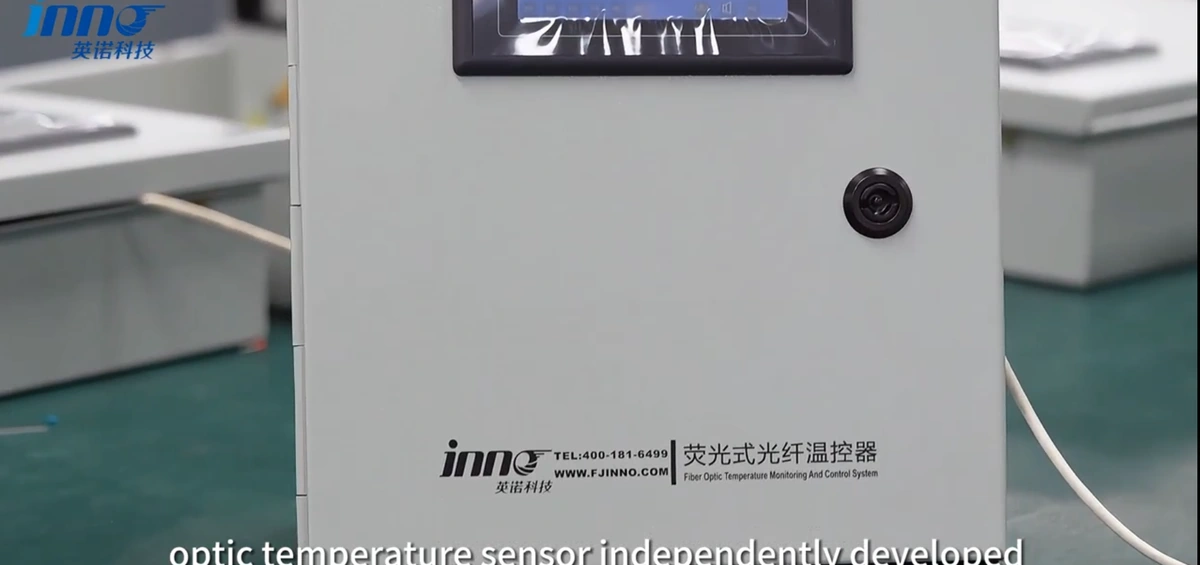
Where several winding locations need long-term temperature data, multiple probes can be connected to an oil-immersed transformer temperature monitoring system, which records the channels together and tracks how they change with load and cooling conditions.
These sensors do not measure insulation ageing. They provide actual winding temperature data and hot-spot temperature data at the selected sensing locations, along with temperature trends under changing load and cooling. That data is one input for evaluating thermal stress and for understanding the conditions under which the transformer ages.
Important: Point Measurement Does Not Automatically Locate Every Hot Spot
A fluorescence fiber optic temperature probe measures the physical location where its sensing tip is installed. It is not a distributed sensor, and the fiber between the sensing tip and the instrument does not measure temperature along its length. One probe measures one defined position.
Fiber optic probes can directly measure temperature at selected or previously identified winding locations, including locations expected to be thermally critical. They do not automatically find an unknown hot spot. If several locations need direct measurement, several probes are required.
Sensor placement therefore has to be considered during transformer design, manufacturing and factory testing, or during an engineering review of accessible measurement locations. Internal winding probes cannot generally be added to an operating oil-immersed transformer after the fact.
New Transformers vs Existing Transformers
The practical options differ between a new transformer and one already in service.
New transformers: Direct winding probes can be planned before final assembly when the transformer design allows it. Probe locations can be agreed with the designer, routed and secured during manufacturing, and verified during factory testing.
Existing transformers: Access to the internal winding is usually limited, and it cannot be assumed that internal probes can be retrofitted. Temperature assessment may rely more on existing instruments, top-oil measurement, a WTI, external measurements and whatever monitoring points are already available.
Which Temperature Data Is Useful for Transformer Ageing Assessment?
Different data sources answer different questions. The table below is not a ranking, since each entry contributes something different to an ageing assessment.
| Measurement / Indicator | What It Shows | Direct or Indirect | Main Limitation |
|---|---|---|---|
| Top-oil temperature | Oil temperature in the upper part of the tank | Direct measurement of oil, indirect for winding | Does not represent local winding temperatures |
| WTI / thermal model | Calculated or simulated winding temperature | Indirect | Depends on model assumptions and calibration |
| Direct winding fiber optic probe | Actual temperature at one selected winding location | Direct | Measures one point only, and placement must be planned |
| Multiple winding probes | Temperatures at several selected locations | Direct | Covers only the locations where probes are installed |
| Load history | How heavily the transformer has been loaded over time | Indirect indicator of thermal stress | Does not capture cooling condition or local temperature |
| DGA / oil condition indicators | Gases and oil properties that reflect degradation or faults | Indirect | Shows resulting condition, not the temperature causing it |
| Furan / insulation assessment | Indicators related to paper degradation | Indirect | Interpretation depends on oil history and reference criteria |
Conclusion
Transformer ageing is strongly affected by the thermal conditions experienced by the insulation system, and the effect is greatest where temperatures are highest. Winding hot-spot temperature provides information that average oil temperature alone cannot fully represent, which is why it features so prominently in discussions of transformer thermal life.
Direct point measurement provides actual temperature data at selected physical locations, and it can be compared with calculated values from a WTI or thermal model. It does not measure ageing itself. Temperature data should be considered together with moisture, oil condition, loading history and other transformer condition information.
If winding temperature or hot-spot measurement is part of a transformer monitoring project, INNO can help review the measurement locations, probe configuration and required monitoring channels.