
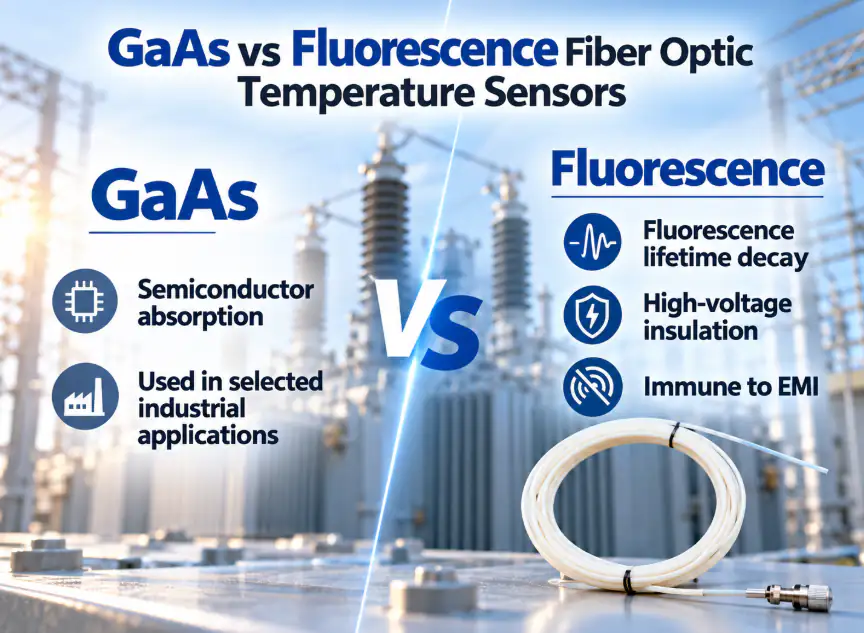
A GaAs fiber optic temperature sensor and a fluorescence fiber optic temperature sensor are both used to measure temperature at a single point using an optical fiber. Both technologies use optical signal transmission and can be applied in environments where electromagnetic interference makes conventional electrical temperature sensing more difficult.
The two technologies are not interchangeable simply because they share the label "fiber optic temperature sensor." A GaAs sensor and a fluorescence sensor rely on different optical properties, use different sensing elements, and are typically read by different monitoring instruments. The name of the technology alone does not determine whether a sensor fits a given application.
Selecting between GaAs and fluorescence should be based on the required temperature range, the accuracy needed for the measurement, the physical structure of the probe, the response behavior required, the installation environment, and compatibility with the monitoring instrument already in use or planned for the project.
What Is a GaAs Fiber Optic Temperature Sensor?
GaAs refers to gallium arsenide, a semiconductor material used as the sensing element at the tip of the optical fiber. The optical absorption characteristics of GaAs change with temperature. Light is sent through the fiber into the GaAs element, and the way the material absorbs or transmits that light shifts as temperature changes.
A monitoring instrument analyzes this optical shift and converts it into a temperature reading. The GaAs element itself does not generate light; it modifies the light passing through it in a temperature-dependent way, and the interrogation unit interprets that change.
What Is a Fluorescence Fiber Optic Temperature Sensor?
A fluorescence fiber optic temperature sensor uses a fluorescent material placed at the sensing tip of the fiber. An excitation light source, delivered through the fiber, causes the fluorescent material to emit light of its own.
The way that emitted light behaves after excitation, particularly its decay over time, is related to the temperature of the sensing tip. The monitoring instrument evaluates this fluorescence decay behavior to determine the temperature at the probe location. A more detailed explanation of how fluorescence fiber optic temperature measurement works is available separately.
INNO's current fiber optic temperature sensing products are based on this fluorescence measurement principle.
GaAs vs Fluorescence: Key Technical Differences
The table below summarizes the main technical distinctions between the two sensing approaches. Where a specific numerical value would depend on a particular product design or vendor specification, this article describes the consideration qualitatively rather than citing a figure.
| Aspect | GaAs Fiber Optic Sensor | Fluorescence Fiber Optic Sensor |
|---|---|---|
| Measurement principle | Temperature-dependent optical absorption of a semiconductor element | Temperature-dependent fluorescence decay of a fluorescent material |
| Sensing element | Gallium arsenide (GaAs) semiconductor sensing element | Fluorescent phosphor or fluorescent compound |
| Optical signal evaluated | Shift in absorption or transmission spectrum | Temperature-dependent fluorescence decay time |
| Measurement type | Point measurement at the sensing tip | Point measurement at the sensing tip |
| Probe construction | Semiconductor element bonded or attached to the fiber tip | Fluorescent element bonded or coated at the fiber tip |
| Temperature range considerations | Determined by the optical properties of the GaAs element used; range depends on the specific product design | Determined by the specific fluorescent material used; range depends on the specific product design |
| Accuracy considerations | Depends on spectral resolution of the interrogation unit and stability of the GaAs element | Depends on the resolution of the decay-time measurement and stability of the fluorescent element |
| Response considerations | Influenced by probe size, thermal mass, and how the element is mounted | Influenced by probe size, thermal mass, and how the element is mounted |
| EMI / RF environment | High EMI / RF immunity along the optical signal path; complete system suitability depends on probe and instrument construction. | High EMI / RF immunity along the optical sensing path; complete system suitability depends on probe and instrument construction. |
| High-voltage measurement | Can be used for high-voltage point measurement because the temperature signal is transmitted optically and conventional metallic sensor wiring is not required at the measurement point. Suitability depends on the complete probe construction. | Well suited to high-voltage point measurement because the sensing signal is transmitted optically and the probe can be configured without conductive electrical signal wiring at the measurement point. |
| Monitoring instrument compatibility | Requires an interrogation unit designed to read GaAs absorption/spectral signals | Requires an interrogation unit designed to read fluorescence decay signals |
| Application selection | Selected based on project temperature range, probe geometry, and available instrumentation | Selected based on project temperature range, probe geometry, and available instrumentation |
Where GaAs Fiber Optic Temperature Sensors Are Commonly Used
GaAs fiber optic temperature sensors are used in industrial temperature measurement, laboratory and research measurement setups, high-voltage environments where electrical isolation is required, and RF or electromagnetic environments where conventional electrical sensors would introduce interference or measurement error.
INNO does not currently manufacture or supply GaAs-based fiber optic temperature sensors. This section is provided for technical comparison purposes only.
Where Fluorescence Fiber Optic Temperature Sensors Are Used
Fluorescence fiber optic temperature sensors are commonly used for monitoring transformer windings, switchgear and electrical connection points, motors and generators, and for high-voltage temperature measurement during testing and commissioning.
They are also used inside MRI systems and other strong magnetic field environments, in microwave and RF test environments, and for general industrial point temperature measurement where dielectric, EMI-immune sensing is required.
Which Technology Should You Choose?
Choosing between GaAs and fluorescence sensing starts with the measurement requirement rather than the sensing technology itself. Relevant factors include:
- The temperature range the application requires — see fiber optic temperature sensor range for a closer look at how range affects sensor and probe selection
- The accuracy needed for the measurement point
- The physical measurement point and access to it
- The probe dimensions that can physically be installed
- The required fiber length between the sensing tip and the instrument
- The response behavior needed for the process being monitored
- The mechanical environment the probe must withstand
- The electrical and EMI environment, including proximity to high voltage or RF sources
- The monitoring instrument that will be used to read the sensor
- The number of independent measurement points required
- How the sensor needs to integrate with existing monitoring or control systems
If a project already uses a particular interrogator or monitoring platform, compatibility with that platform is itself a primary selection criterion, since GaAs sensors and fluorescence sensors are read by different types of interrogation units. For a broader walkthrough of the selection process, see how to choose a fiber optic temperature sensor.
GaAs and Fluorescence Are Both Point Temperature Sensing Technologies
GaAs and fluorescence fiber optic temperature sensors are both point sensing technologies. Each probe corresponds to a defined sensing location, and a separate probe is required for each additional measurement point.
Neither technology, as described in this article, provides continuous temperature distribution along the length of an optical fiber. If a project requires continuous temperature measurement along tens of meters or kilometers of fiber, that requirement falls under distributed temperature sensing (DTS), which uses a different architecture. A detailed comparison of point fiber optic temperature sensing and DTS is covered separately.
Questions to Ask Before Selecting a Fiber Optic Temperature Sensor
- What temperature range is required?
- Where will the sensing tip be installed?
- What probe diameter and structure can physically be accommodated?
- How long must the optical fiber be?
- Is the environment high voltage, RF, microwave, or a strong magnetic field?
- How many independent measurement points are required?
- What monitoring instrument will be used to read the sensor?
- What communication or monitoring output format is required?