
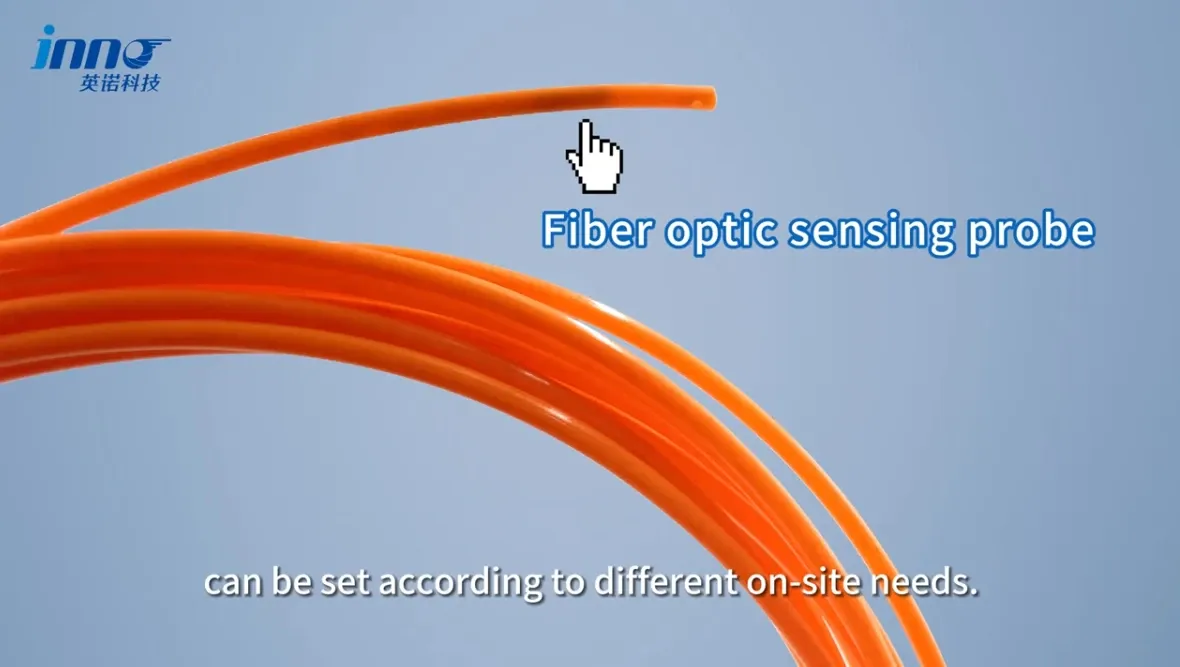
Selecting a high temperature fiber optic sensor is not only about the maximum temperature printed on a datasheet. The fiber optic temperature probe, its sensing tip, the optical fiber and the monitoring instrument all have to suit the actual application. Engineers also need to know where the high temperature occurs, how the probe is built, how the fiber is routed, what accuracy and response the process needs, and whether the instrument can read the probe.
This checklist covers seven items to confirm before selecting a probe for an elevated-temperature measurement point. It focuses on fluorescence-based point sensing, the technology INNO works with, and it does not repeat the general explanations found in other articles on this site.
Key Takeaways
- The maximum sensor temperature is only one selection factor. It does not describe the whole application.
- The sensing tip, probe body, fiber and protective sheath may experience different temperatures.
- Point sensing measures the selected physical location only. One sensing tip is one defined measurement point.
- Accuracy and response should be checked at the required operating range, not assumed from the range specification.
- Fiber routing can be as important as sensing-tip capability.
- The probe and the monitoring instrument must use compatible sensing technology.
- Multiple independent points require multiple probes and compatible active channels.
What Is a High-Temperature Fiber Optic Sensor?
A high-temperature fiber optic sensor is a fiber optic temperature sensor designed or configured for temperature measurement at elevated-temperature points. The term has no single standard threshold. What counts as "high" depends on the application, the probe and the instrument.
This article refers to a temperature sensing device, not to communication fiber or optical cable ratings. In a fluorescence point-sensing system, the measurement chain looks like this:
sensing tip
   ↓
optical fiber
   ↓
monitoring instrument
   ↓
temperature data
The sensing tip is the defined temperature measurement point. The optical fiber carries optical signals between the tip and the instrument. The fiber does not automatically measure temperature along its length. The principle behind this is explained in fluorescent fiber optic temperature sensing: the instrument reads the optical response of the sensing tip and derives the tip temperature from it.
1. Confirm the Required Temperature Range
Direct answer: define the temperature the measurement point actually experiences, then compare it with the sensor's verified range.
Start by writing down four values where they apply:
- minimum expected temperature
- normal operating temperature
- maximum expected temperature
- short-duration excursions, if the process has them
The question is not "What is the highest sensor specification available?" The better question is "What temperature does the actual measurement point experience?" The application requirement and the sensor's maximum rating are different things. A sensor that covers the maximum value but not the normal operating range, or one that is only marginally rated for the real peak, may not be a good match.
Excursions matter because a brief peak can still stress the probe. Confirm with the supplier how the specific probe handles the temperature profile of your process rather than relying on a single number. This article does not give a universal limit, since the figure depends on the specific probe, sensing material, construction and instrument. For more on how range is defined and selected, see fiber optic temperature sensor range.
Selection question: what are the minimum, normal, maximum and excursion temperatures at the exact point to be measured?
2. Check the Probe Tip and Probe Construction
Direct answer: the sensing principle may support elevated temperature, but the complete probe has to be suitable too.
High-temperature capability does not depend on the sensing material alone. A probe is a built assembly, and each part has to tolerate the application. Depending on design, the following may be relevant:
- the probe tip
- the probe housing
- a protective tube
- coatings
- the adhesive or bonding method
- mechanical protection
A probe whose sensing element can respond at an elevated temperature may still be limited by another part of its construction. Different probe structures exist for different installation conditions, and the right one depends on how the probe is mounted, what it touches and what it is exposed to. You can review the available structures in the fiber optic temperature probes category.
Avoid assumptions about materials. Probes are not all built the same way, so confirm the construction of the specific probe against the conditions at your measurement point.
Selection question: is every part of the probe, not only the sensing element, specified for the temperature and environment at the installation point?
3. Check the Fiber and Protective Sheath Temperature Capability
Direct answer: the sensing-tip temperature is not necessarily the temperature along the fiber route, so check the fiber and sheath separately.
Two situations are common. In one, the sensing point sits inside a hot zone while the fiber leaves that zone and reaches a cooler monitoring location. In the other, a longer section of fiber is exposed to elevated temperature along its route. These need different checks.
Confirm each of the following separately:
- sensing tip capability
- probe body capability
- fiber coating capability
- protective sheath capability
- connector location and its surrounding temperature
- the external routing environment
High Temperature at the Probe Does Not Mean the Entire Fiber Is at the Same Temperature
Fluorescence point sensing measures the temperature at the sensing tip. The fiber is the optical signal path. It does not report a temperature profile along its length.
That does not make the fiber's temperature exposure irrelevant. The fiber coating, the sheath and the connectors still have material and mechanical limits. The route has to be evaluated for the temperature each section will actually see.
Selection question: which sections of the fiber and sheath enter the hot zone, and are they rated for that exposure?
4. Verify Accuracy at the Required Temperature
Direct answer: range and accuracy are separate selection criteria, so check accuracy where the application operates.
A probe that covers a wide range is not automatically accurate across all of it. What matters is how the measurement performs in the portion of the range your process uses, particularly around the control or alarm points.
Measurement performance also belongs to the complete chain, not to the fiber alone. It depends on:
- the probe
- the optical path
- the monitoring instrument
- calibration
Check the verified accuracy specification for the selected probe and instrument configuration, and confirm it applies at the temperature you care about. This article does not quote accuracy values, because they depend on the specific configuration.
Selection question: what accuracy is verified for this probe and instrument combination at my operating temperature, and does the application actually need it?
5. Match Response Time to the Thermal Process
Direct answer: a sensor with a broad high-temperature range is not automatically right for a fast-changing process.
Response time depends on several practical factors:
- probe geometry
- thermal mass
- thermal contact with the target
- installation method
- the target material
- the dynamics of the process
As a concept, slow thermal monitoring of a large heated body places few demands on response. A rapid heating process is different, because a probe that responds slowly may lag behind the real temperature and under-report fast changes. Thermal contact matters as much as the probe itself: a well-built probe with poor contact will still read slowly.
Define the process dynamics first, then ask what response the probe needs to deliver in that installation. For a closer look at how response is defined, see fiber optic temperature sensor response time.
Selection question: how quickly does the temperature change at this point, and can the probe, mounted as planned, follow it?
6. Plan the Fiber Length and Routing
Direct answer: choose fiber length to follow the actual routing, not the other way around.
Walk the route from the sensing point to the instrument and note each stage:
- the distance from the sensing point to the monitoring instrument
- internal routing inside the equipment
- the feedthrough location
- external routing
- bend protection
- mechanical protection
- the length of fiber that passes through the high-temperature zone
- the connector position
- service access for maintenance
Selecting a length before planning the route often leads to a fiber that is too short to reach the instrument or too long to manage safely. Length also interacts with item 3: a longer path through a hot region means more fiber and sheath to qualify for that exposure. Fiber length should follow the actual route, with allowance for service access.
For more on how probe length and structure are specified, see fiber optic temperature probe length and structure.
Selection question: what is the actual route from the sensing point to the instrument, and where along it are the hot sections, bends and connectors?
7. Confirm Monitoring Instrument Compatibility
Direct answer: a high-temperature probe cannot be selected separately from its monitoring instrument.
A fluorescence lifetime probe requires a compatible fluorescence measurement instrument. Do not assume that any fiber optic interrogator can read any optical temperature sensor. Different fiber optic temperature technologies use different optical principles, for example fluorescence lifetime, GaAs absorption, FBG and distributed temperature sensing, and they are not automatically read by the same instrument.
Check the following:
- sensing technology
- optical compatibility
- channel count
- probe compatibility
- the required measurement range
- data output
- monitoring integration
The instrument is also where temperature data becomes usable output. For the instrument side, see fiber optic temperature transmitters and hosts. The goal here is only to verify that the probe and instrument are designed to work together.
Selection question: is this probe designed to work with this instrument, and does the instrument provide the channels and outputs the project needs?
High-Temperature Fiber Optic Sensor Selection Checklist
| Check | Question to Ask | Why It Matters |
|---|---|---|
| Temperature range | What does the actual measurement point experience? | The application requirement is not the same as the sensor's maximum rating |
| Probe construction | Is the whole probe suited to the conditions? | The sensing principle alone does not make the assembly suitable |
| Fiber / sheath temperature capability | Which fiber sections are exposed to heat? | Tip temperature and routing temperature can differ |
| Accuracy | What is verified at my operating temperature? | Range and accuracy are separate criteria |
| Response time | Can the probe follow the process? | A broad range does not guarantee a fast response |
| Fiber length / routing | What is the real route to the instrument? | Length should follow routing, and routing affects exposure |
| Instrument compatibility | Can the instrument read this probe? | Different optical principles need different instruments |
A Practical Selection Sequence
- Define the physical measurement point.
- Define the normal and maximum expected temperature.
- Determine how much of the probe and fiber is exposed to high temperature.
- Confirm the required accuracy.
- Define the process response requirements.
- Plan the fiber route.
- Count the independent measurement points.
- Match the probes to a compatible monitoring instrument.
- Confirm the required output and system integration.
This sequence is specific to elevated-temperature points. For a broader process that also covers ordinary temperature applications, see how to choose a fiber optic temperature sensor.
How Many High-Temperature Fiber Optic Sensors Are Needed?
The number depends on how many independent measurement points the application has. For point sensing, the relationship is:
1 independent measurement point
≈ 1 probe
≈ 1 compatible active measurement channel
For example, four selected points would normally need four probes and at least four compatible channels. This is a configuration example, not a universal rule.
Multiple probes do not make the system a distributed temperature sensing system. They provide multiple independent point measurements, each at a location the engineer chooses. A single probe represents only its own sensing point, not a large thermal area. When several points feed one system, the instrument and software side becomes part of a fiber optic temperature monitoring system.
High Temperature Is Not Always the Hardest Part of the Application
Many projects combine elevated temperature with other conditions that affect the choice:
- high voltage
- strong electromagnetic interference
- RF or microwave fields
- strong magnetic fields
- limited installation space
- rapid temperature change
- mechanical vibration
- chemical exposure
Do not select a probe based only on the maximum temperature. In some applications the limiting factor is the installation space, the electrical environment or the chemical exposure rather than the heat itself. The optical measurement chain is often used because the sensing point can remain electrically isolated and the optical signal path has high resistance to electromagnetic interference. The wider measurement context is covered under fiber optic temperature measurement.
Where High-Temperature Fiber Optic Sensors May Be Used
These are areas where elevated-temperature point sensing may be required. Not every case in these areas involves high temperature.
- Industrial heating: point measurement inside heated equipment or processes.
- High-voltage electrical equipment: temperature points where electrical isolation is needed.
- Power electronics testing: measurements at hot components during testing.
- RF and microwave heating: measurement in fields that can disturb electrical sensors.
- Laboratory thermal testing: controlled point measurement in test setups.
- Selected transformer and motor measurement points: specific internal locations of interest.
Common Mistakes When Selecting a High-Temperature Fiber Optic Sensor
- Looking only at the maximum temperature number. The number does not describe probe construction, fiber exposure, accuracy or response.
- Ignoring the temperature exposure of the fiber and protective sheath. The sensing tip may not be the only part exposed to heat.
- Assuming range and accuracy are the same specification. A wide range does not mean the accuracy requirement is met at your operating point.
- Ignoring thermal contact and response requirements. Installation affects how quickly the probe follows the process.
- Selecting fiber length before planning the routing. The route determines how much fiber is needed and how it is exposed.
- Assuming any probe works with any fiber optic instrument. Compatibility depends on the sensing principle and instrument design.
- Assuming one probe represents a large thermal area. A probe measures its own sensing point.
Conclusion
Selecting a high-temperature fiber optic sensor requires more than checking the maximum temperature range. The main points to confirm are the temperature range at the real measurement point, the probe construction, the temperature exposure of the fiber and sheath, accuracy at the operating temperature, response to the thermal process, the fiber route and length, and instrument compatibility.
The correct sensor is the one whose complete measurement chain matches the actual thermal and installation conditions.
If your project requires point temperature measurement in a high-temperature, high-voltage or electromagnetically demanding environment, INNO can help review the sensing point, probe construction, fiber routing and monitoring instrument requirements.