
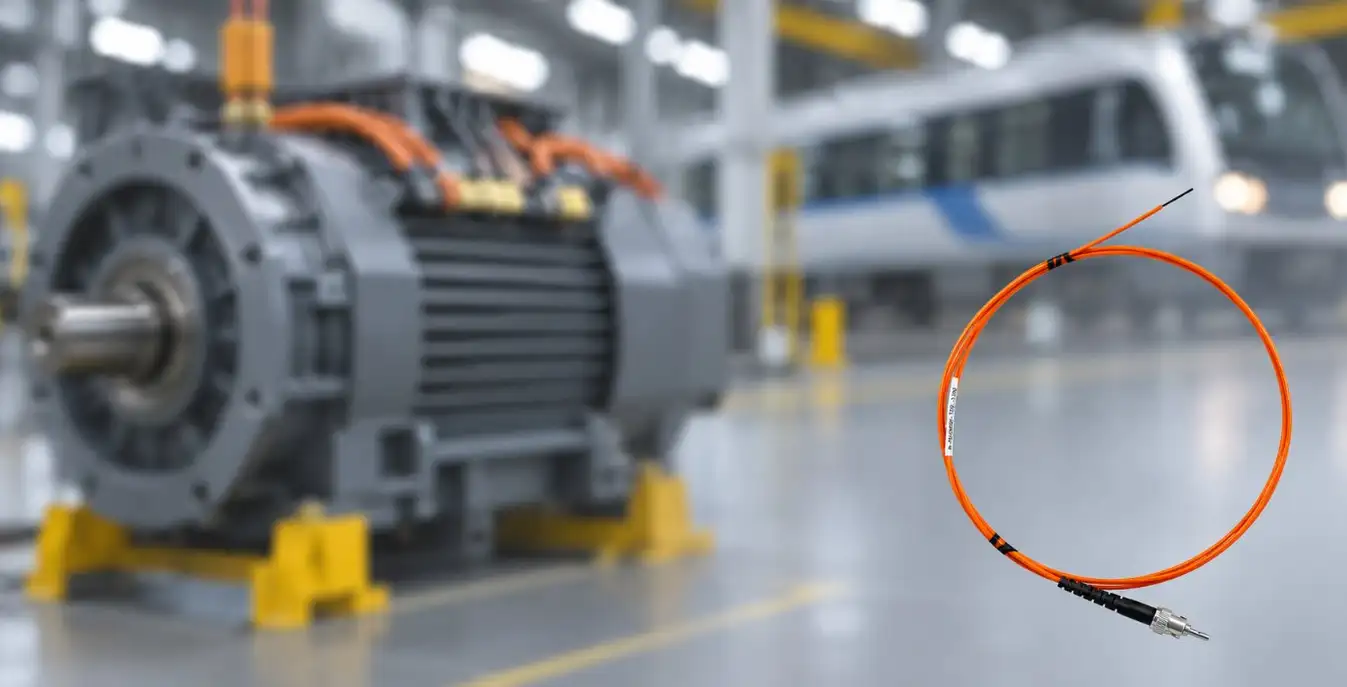
- Core Purpose: Traction motor winding temperature monitoring tracks real-time thermal changes inside stator windings to protect insulation life and support reliable train operation.
- Direct Sensing: Fluorescent fiber optic probes sit directly inside stator slots or winding end turns, capturing localized heat where electrical stress is highest.
- Stable Performance: Optical signals remain unaffected by electromagnetic interference from traction inverters and high-voltage switching systems.
- Flexible Integration: Compact, electrically insulated probes fit easily into tight motor spaces without altering existing winding designs.
- OEM Customization: INNO supplies tailored fiber optic probes, multi-channel monitors, and data interfaces built for railway motor manufacturers and system integrators.
Why Monitor Traction Motor Winding Temperature?
Railway traction motors operate under demanding duty cycles every day. Metro trains experience frequent starts and stops between closely spaced stations, while high-speed trains and electric locomotives sustain heavy loads over long distances. Under these conditions, copper losses and rapid acceleration generate concentrated heat inside stator windings.
Accurate traction motor winding temperature monitoring gives operators clear visibility into how windings respond to changing loads. Early identification of localized hot spots helps engineering teams optimize cooling, plan condition-based maintenance, and extend motor service life. As a core part of motor and generator temperature monitoring, direct winding data turns daily thermal trends into actionable maintenance decisions.
Where Are Fiber Optic Temperature Sensors Installed?
Effective thermal oversight depends on placing probes where heat naturally accumulates. Because traction motor stators have compact internal geometries, engineers typically select specific winding zones based on thermal design models and airflow patterns.
| Installation Location | Monitoring Role |
|---|---|
| Stator Winding Slots | Captures core winding temperature directly between coils and stator laminations during peak torque. |
| Winding End Turns | Tracks heat buildup in overhangs where cooling airflow may vary across the motor housing. |
| Selected Winding Hot Spots | Monitors predicted thermal peak zones identified during motor design or factory type testing. |
| Multiple Winding Measurement Points | Compares thermal balance across phases and detects uneven heating early. |
Why Choose Fiber Optic Temperature Sensors for Traction Motors?
Conventional electrical sensors often struggle in compact, high-voltage traction environments. Fluorescent fiber optic technology addresses these operational demands directly:
- Direct Temperature Measurement: Installing fluorescent probes directly at chosen stator winding positions measures actual temperature changes at the exact point of contact, giving engineers dependable thermal visibility under live loads.
- Electrical Insulation: Non-conductive optical fibers provide inherent electrical insulation, making them well suited for direct placement inside high-voltage motor windings.
- EMI Immunity: Traction inverters and power converters generate intense electromagnetic fields during acceleration and regenerative braking. Optical measurement signals remain immune to this interference, delivering clean, stable readings.
- Small and Flexible Probes: Slim, flexible probe designs route cleanly into narrow stator slots and tightly packed end turns without disturbing winding geometry.
- Multi-Point Monitoring: Connecting several probes to a single multi-channel transmitter enables multi-point temperature monitoring across all three phases simultaneously.
- Continuous Temperature Monitoring: Automated data acquisition tracks winding temperatures continuously, supporting real-time alarms and seamless integration with train control or test-bench systems.
INNO Fiber Optic Temperature Monitoring Solutions
Designed specifically for traction motor stators and windings, INNO provides a complete measurement chain built for railway OEMs and system integrators. At the sensing point, fiber optic temperature probes for motor windings use fluorescent decay principles to convert local winding heat into an optical signal.
Each probe connects to a multi-channel fiber optic temperature monitor that processes optical signals in real time. From there, the unit provides local temperature display, configurable alarm outputs, and remote data communication for onboard diagnostic systems or factory test stands.
Because every traction motor platform has distinct mechanical and electrical requirements, INNO delivers custom OEM temperature sensing solutions. Engineering teams can specify probe outer diameters, armored or flexible fiber lengths, channel counts matching their exact measurement points, and preferred communication interfaces to fit seamlessly into existing motor assemblies.
Applications in Railway Traction Motors
- Metro Traction Motors: Continuous thermal tracking supports frequent start-stop cycles and helps transit operators manage peak-hour load stress.
- High-Speed Railway Traction Motors: Stable, EMI-immune sensing provides accurate winding data during sustained high-speed cruising and heavy power conversion.
- Electric Locomotive Traction Motors: Multi-point monitoring tracks thermal performance across heavy-haul grades and long-duration freight runs.
- Traction Motor Manufacturing and Testing: Motor builders use multi-channel fiber optic systems during factory type tests and temperature-rise trials to verify thermal margins before delivery.
Get a Tailored Traction Motor Monitoring Proposal
Ready to integrate reliable fluorescent fiber optic sensing into your next traction motor project? Please contact INNO for product recommendations and OEM engineering support. Sharing the following details will help our team prepare an accurate configuration:
- Traction motor type
- Preferred temperature monitoring locations
- Number of measurement points
- Probe dimensions or installation space
- Required data interface